


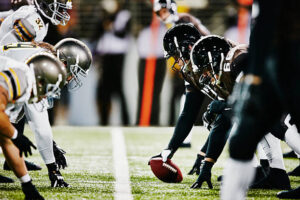
WHAT’S THE SUPER BOWL REALLY DO FOR THE ECONOMY? _ When the Super Bowl is played next month Santa Clara, California, the economic impact to the area is expected to be $1.3 billion. Or $630 million. Or $360 million. It depends on who you believe. A few years back one study done before a Super Bowl in Dallas (by the North Texas Super Bowl Host Committee) pegged the economic impact for a host city at $611 million. However, other estimates say a Super Bowl actually brings in $30 million to $40 million for the host city. One reason “economic impact” announcements from host cities for events seems very high is because the city will use “indirect” economic benefits of tourism. The idea is tourists spend money at hotels and restaurants, which take that money and employ people who spend money on other goods and services, which in turn employ other people, and so on so forth to create “indirect” economic “impact” in the region. This multiplier assumes for every $1 of direct spending, there is another $0.65 in “indirect spending.” This part is not based on actual surveys but is an estimate used by economic development agencies who want to report large impacts.
GO GETCHA SOME MONEY! _ Our government loves to take our money, but it also tries to help us track down money we’re owed. Over on USA.gov you can search for money owed to you by former employers in the form of back wages and pensions. You can also search for old bank accounts, as well as tax refunds you never received. Best of all, the searches are free. Well, sort of — USA.gov is funded by our tax dollars.
YOUR DANCING STYLE IS AS UNIQUE YOUR FINGERPRINT _ Research (University of Jyväskylä in Finland) tells us that every single person has their own unique way of dancing, and computers were able to tell the identity of dancers with startling accuracy. Regardless of the type of music, from jazz to reggae, the vast majority of people have a uniform uniqueness to their dancing style. It’s this personality in each of our dance moves that makes it easy for computers to ID dancers. The research team hadn’t initially set out to use computers to identify dancers. The original plan was to use machine learning to determine the musical genre participants were dancing to at a particular moment. In total, 73 dancers took part in the experiment. Each participant was motion captured as they danced to eight different genres: rap, reggae, blues, country, electronic dance, jazz, and metal. They were told to dance in whatever way felt natural. The machine learning algorithm actually wasn’t very good at identifying the musical genres, only offering a correct guess about 30 percent of the time. However, the computer was much better at identifying the dancers based on their movements. Among the 73 participants, the computer accurately determined who was dancing 94 percent of the time.

